 The Khyat Institute
Ticked, Not Seen: How Indian Tourism Stopped Asking Questions
Indians now travel more than ever. We are not learning more than ever.
Abstract
Indian tourism has become a list to be ticked, not a place to be understood. The cost is not only lost curiosity abroad but a blindness at home: travellers who admire civility elsewhere without asking why they do not practise it here.
The queue at Dhungri
Stand outside the Hidimba Devi temple in Manali on any summer weekend and you will see the same scene. A queue that snakes down through the deodars. Phones raised at the four-tiered wooden roof. A selfie at the door, a quick bow, and on to the next stop.
Ask anyone in that queue who Hidimba was, and a few will remember the Mahabharata: the “rakshasi” who married Bhima.1 The Institute uses the epic’s term only in quotation marks. In the Kullu valley she is a devi, not a demon: the state’s own Kullu Dussehra records list her among the valley’s deities, and Sahapedia describes her as an old indigenous deity of the region (both cited below). Very few will know that the temple was built in 1553 by Raja Bahadur Singh around a cave where she is said to have meditated,2 Hidimba Devi Temple, Wikipedia. https://en.wikipedia.org/wiki/Hidimba_Devi_Temple or that the valley still holds a fair in his memory every Shravan.3 “Hidimba Temple, Manali,” Incredible India (Ministry of Tourism). https://www.incredibleindia.gov.in/en/himachal-pradesh/manali/hidimba-temple Fewer still will know why the shrine has no idol, only a stone.
And almost nobody will ask the obvious question: why does a valley worship as its mother a woman the epic calls a “rakshasi”?
The epic gives her that label because she was born to the forest people who lived outside the settled, Vedic world, the sister of a man-eating chief whom Bhima killed. In the epic’s telling, she is the outsider. In the Kullu valley, she is the insider. Locals call her Hadimba Mata. The Kullu royal family calls her Dadi, grandmother, because tradition holds that she gave the kingdom to Bihangmani Pal, the first king of the line.4 “Devi Hidimba,” Kullu Dussehra (Government of Himachal Pradesh). https://kulludussehra.hp.gov.in/?p=740 She is remembered as an old, indigenous deity who helped the kings establish their rule.5 “Kullu Dussehra of Himachal Pradesh,” Sahapedia. https://www.sahapedia.org/kullu-dussehra-of-himachal-pradesh-0 To this day, Kullu Dussehra cannot begin until her palanquin arrives from Manali. When it reaches the palace, she calls the royal family out to perform the rites, and she leads the procession of the valley’s gods.6 “Tales of Kulu Dasehra,” The Tribune, 4 October 2000. https://www.tribuneindia.com/2000/20001004/himachal.htm ; “Goddess Hadimba leaves for Kullu to start Dussehra,” Discover Kullu Manali. https://discoverkullumanali.in/?p=1436
That is a remarkable story. A figure the epic placed at the edge of the civilised world is, in the place she actually lived, its matriarch. It tells you how the Himalaya absorbed the Mahabharata on its own terms. It is also exactly the kind of story the selfie queue walks straight past.
A valley of rishis
Walk three kilometres to Old Manali and the queue thins, but the pattern holds. The town takes its name from Manu-Alaya, the abode of Manu. Local tradition holds that after the great flood, Manu stepped off his ark here to begin human life again.7 “Manali, Himachal Pradesh,” Wikipedia. https://en.wikipedia.org/wiki/Manali,_Himachal_Pradesh The temple is said to be the only one in the country dedicated to him.8 “Manu Temple Manali,” Tour My India. https://www.tourmyindia.com/states/himachal/manu-temple-manali.html Here is a chance to think about one of the most argued-over figures in Indian thought. You need not agree with Manu. You should at least know what you are bowing to.
Manu is not alone. The upper Beas valley is, in its own memory, a valley of rishis. Across the river, the village of Vashisht is named for the sage Vasishtha, guru of the Ikshvaku line. A few kilometres up the road at Goshal, villagers worship Gautam Rishi alongside Ved Vyas, the compiler of the Mahabharata, whose name the Beas river itself carries. Every winter, nine villages around Goshal switch off their televisions and radios for 42 days, because they believe Gautam Rishi has left to attend a council of the gods and must not be disturbed.9 “9 villages in Kullu district go silent for 42 days to appease deity,” The Tribune. https://www.tribuneindia.com/news/himachal/9-villages-go-silent-for-42-days-to-appease-deity-470739/amp ; “Gautam Rishi,” Kullu Dussehra (Government of Himachal Pradesh). https://kulludussehra.hp.gov.in/devtas-of-manali/gautam-rishi/ Over the ridge, the people of Malana still live under the authority of Jamlu, the sage Jamadagni, father of Parashurama.10 “Jamdagni Rishi,” Kullu Dussehra (Government of Himachal Pradesh). https://kulludussehra.hp.gov.in/?p=512 Local histories add Parashar, Kapil, Markandeya and Shringi to the roll.11 “History of Kullu” (study notes). https://www.collegesidekick.com/study-docs/5883413
Whether you read these as history, myth or something in between, the tradition is plain: the people of this valley believe the authors of Indian philosophy walked here. The tourist who drives from Mall Road to Solang for a snow-scooter ride passes through Goshal without knowing it.
This brief is not about the stress Indian families pack into a five-day holiday, though that deserves its own essay. It is about something narrower: travel without understanding. The place reduced to a backdrop, the visit reduced to a tick.
The checklist
The checklist tourist does not travel to a place. He travels to a list of places. Success is measured in boxes ticked and photographs posted, not in anything learned.
This would be harmless if the list were short. It is not. Indian outbound travel is growing faster than almost any market in Asia. Thailand received about 2.48 million Indian visitors in 2025, and Vietnam’s Indian arrivals rose by nearly half in a single year.12 “How India Traveled in 2025: What the Data Shows,” Skift, 7 January 2026. https://skift.com/2026/01/07/how-india-traveled-in-2025-what-the-data-shows/ At home, domestic tourism runs into the billions of visits. A habit repeated at that scale is no longer a private failing. It is a national one.
At home: Kailasa without the question
Consider Cave 16 at Ellora. The Kailasa temple was not built. It was carved, downward, out of a single basalt cliff. Inscriptions link it to the Rashtrakuta king Krishna I in the eighth century, though the work may have continued under his successors for more than a hundred years.13 “Kailasa: The Majestic Temple of Ellora,” Indian Culture portal (Ministry of Culture). https://indianculture.gov.in/stories/kailasa-majestic-temple-ellora ; Rana Safvi, “Ellora Cave 16.” https://ranasafvi.com/ellora-cave-16/amp/ It is among the largest single rock excavations anywhere in the world.14 “Ellora’s Kailasa: The 1200-year-old temple carved from a single rock,” 30 Stades. https://30stades.com/travel/ellora-caves-kailasa-temple-aurangabad-carved-from-single-rock-architecture
That raises questions any curious person should ask. How did the carvers plan a temple in reverse, removing rock they could never put back? Who paid for it, and why? What did a Rashtrakuta king gain by carving Shiva’s mountain into the Deccan?
The checklist tourist does not ask. He photographs the elephants in the courtyard and leaves.
Abroad: our own history, waiting
The failure is sharper abroad, because there the history the tourist ignores is often his own.
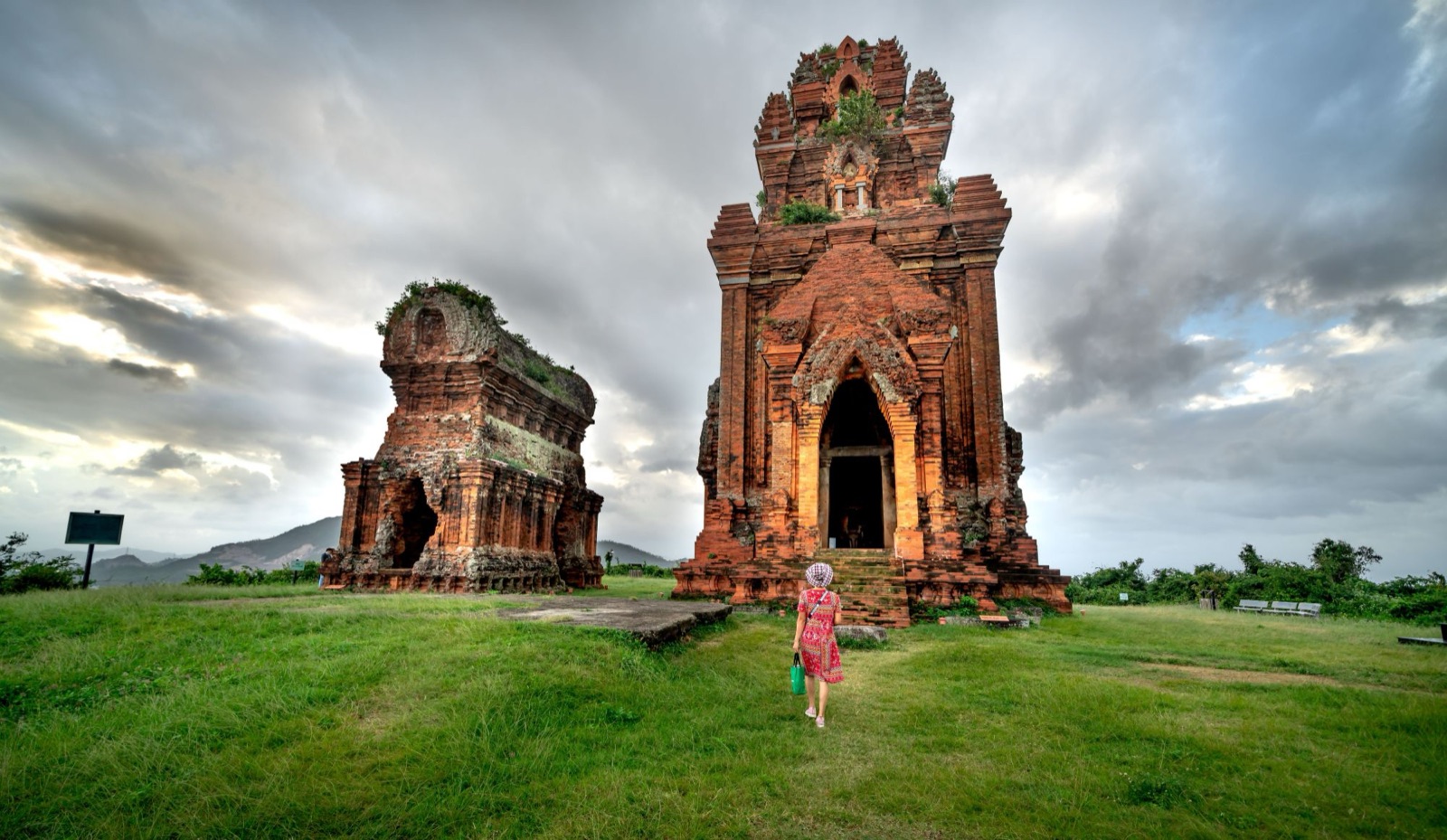
Indian arrivals to Vietnam have surged. Most go to Da Nang, Hoi An, Phu Quoc. An hour from Hoi An lies Mỹ Sơn, a valley of brick tower-temples that was the religious and political heart of the Champa kingdom from the fourth to the thirteenth century. UNESCO describes it as a culture that took its spiritual origins from Indian Hinduism and made them its own.15 “My Son Sanctuary,” UNESCO World Heritage Centre. https://whc.unesco.org/en/list/949/
Champa did not vanish entirely. In Vietnam’s south-central provinces, the Balamon Cham still practise a Shaivite Hinduism that has survived centuries of isolation from India. They are often described as one of only two surviving Hindu peoples of non-Indian origin in the world, the other being the Balinese.16 “Hinduism in Vietnam,” Wikipedia. https://en.wikipedia.org/wiki/Hinduism_in_Vietnam Their community today faces pressure from conversion and loss of identity.17 “The Conversion to Protestantism: A Challenge in Ethnic and Religious Life of Brahmanism Cham People in Ninh Thuan Province, Vietnam,” Tattva Journal of Philosophy, Christ University. https://journals.christuniversity.in/index.php/tattva/article/view/1052
How many of the three-quarters of a million Indians who visited Vietnam last year went looking for them? The same question can be asked of Bali, where Indian tourists fill the beach clubs of Seminyak and rarely the temple ceremonies of the interior.
Selective memory: Goa
Then there is Goa, where the checklist does real damage.
Visitors to Old Goa queue at the Basilica of Bom Jesus to see the tomb of Francis Xavier. Few know that in 1545 Xavier wrote to the Portuguese king asking for an Inquisition in Goa. It arrived in 1560 and ran, with one brief pause, until 1812.18 “Goa Inquisition,” Wikipedia (Xavier’s 1545 letter, dates, xenddi tax, destruction of records). https://en.wikipedia.org/wiki/Goa_Inquisition
What it enforced was a regime built to end Hindu life in the Portuguese territories. Public Hindu worship was banned. Hindus were barred from employing Christians, and Christian labourers from working Hindu land.19 “Portuguese India,” New World Encyclopedia. https://newworldencyclopedia.org/entry/Portuguese_India The temples fell in waves: about 160 on the island of Goa by 1566, some 300 in Bardez during a Franciscan campaign in 1566–67, and in Salcete in 1567, where one chronicler counted 280. A royal letter of 1569 recorded that every Hindu temple in Portugal’s Indian territories had been burnt and razed.20 “Goa government proposes to reconstruct temples destroyed during Portuguese regime,” Hinduism Today, 29 October 2023 (temple counts, 1569 royal letter, 2023 budget). https://www.hinduismtoday.com/hpi/2023/10/29/goa-government-porposes-to-reconstruct-temples-destroyed-during-portuguese-regime/ ; Salcete figure of 280 from Francisco de Souza, as cited in A. K. Priolkar, The Goa Inquisition (1961). https://quotewise.io/q/55x89d/ When Hindus carried their gods across the border and rebuilt temples there, a church council in 1585 asked the king to forbid them even from paying for those.21 A. K. Priolkar, The Goa Inquisition (1961), on the 1585 Concilio Provincial. https://quotewise.io/q/2kq63z/ From 1705 to 1840, Hindus paid the xenddi, a tax comparable to the jizya.18
At least 16,202 people were summoned before the tribunal. Fifty-seven were burned at the stake and 64 more in effigy.22 “Inquisition de Goa” (French Wikipedia mirror), for 16,202 summoned. https://franco.wiki/fr/Inquisition_de_Goa.html ; “Christianity in Goa,” Wikipedia, for 57 burned and 64 in effigy. https://en.wikipedia.org/wiki/Christianity_in_Goa Voltaire wrote that Goa was sadly famous for an Inquisition contrary to both humanity and commerce.19 Teotónio de Souza, one of Goa’s foremost historians of the period, has said plainly that Xavier could not have been unaware of the tribunal’s brutality.23 “Xavier was aware of the brutality of the Inquisition,” interview with Teotónio R. de Souza, Deccan Herald. https://www.deccanherald.com/amp/story/opinion/xavier-aware-brutality-inquisition-2486112 The Hindus who refused to bend fled with their gods into the territories the Portuguese did not hold, which is why Goa’s great temples stand in Ponda today and not in the Old Conquests.24 Pilar Museum, on temple destruction in the Old Conquests. https://pilarmuseum.org/?p=26 ; “Goa traditions,” Bhakti Bharat. https://bhaktibharat.org/festivals/ganesh-chaturthi/goa-traditions
A short walk from the basilica stands a black basalt pillar. Goans have called it the Hath Katro Khambo, the hand-cutting pillar, for generations. There is substantial evidence that it earned that name.
First, the pillar is itself a trophy of conquest. It was assembled from two pillars of a demolished Hindu temple and turned into a symbol of Portuguese authority.25 “Exploring the Historic Pillory of Old Goa,” Herald Goa. https://www.heraldgoa.in/?p=4411 A short Old Kannada inscription on it, found by Goa’s own Director of Archives, points to a Shiva temple, most likely the Saptanath temple on Divar island.26 “A centuries-old pillar in Goa is causing controversy about colonial history in India,” Crux, April 2026. https://cruxnow.com/church-in-asia/2026/04/a-centuries-pillar-in-goa-is-causing-controversy-about-colonial-history-in-india ; “Haat Katro Khamb: A lone pillar that stands witness to horrors of inquisition,” Hindu Janajagruti Samiti. https://www.hindujagruti.org/hatkatro-khaamb-history Second, a Portuguese pelourinho was not ornamental. It was where the colonial town administered public punishment, and studies of Portuguese pillories record hands being cut off at the pelourinho and left hanging on it.2527 Luís Chaves, “Os Pelourinhos Portugueses,” Revista de Guimarães (in Portuguese). https://www.csarmento.uminho.pt/site/files/original/44efd4ef0a9b2e2f242d2ef9b81ffdbd75bdcff0.pdf Third, even the Goan historian Percival Noronha, no partisan of the Hindu-nationalist reading, accepted that hands were cut off at the site, though he dated the practice before the Portuguese.28 “Pelourinho Novo,” Wikipedia (Percival Noronha’s view; 2026 notification). https://en.wikipedia.org/wiki/Pelourinho_Novo And the Konkani name itself has survived four centuries of foreign rule.
Some historians call the story unproven and have objected to the official name.29 “Goan historian challenges new name for Old Goa pillar,” The Goan. https://www.thegoan.net/goa-news/goan-historian-challenges-new-name-for-old-goa-pillar/146048.html The Institute does not accept that verdict. The evidence points one way: a pillar of public punishment, raised from the stones of a broken temple, in a city where Hindu worship was a crime and refusing the faith carried a price, bearing a name that four centuries of Goans would not let go. The one archive that could have recorded every sentence passed is gone, because the Inquisition destroyed most of its own records when it was abolished.18 When the perpetrator burns the archive, the absence of paper is not an acquittal. The memory, the stone and the law of the time all testify, and together they make a case far stronger than the doubt raised against it.
The state has begun, late, to act. In 2023 Goa’s budget set aside money to rebuild temples destroyed under Portuguese rule.20 In 2026 the archaeology department notified the pillar as a protected monument under its Konkani name.28 These are first steps. But the site of the Palace of the Inquisition, where prisoners were held and tried, still has no memorial. As recently as September 2026, citizens were still petitioning for the site to be excavated and its history put in textbooks.30 “Demand to safeguard Inquisition-era evidence in Goa,” Hindu Janajagruti Samiti. https://www.hindujagruti.org/news/211930.html ; Marathi report of the 30 September 2026 press conference. https://www.hindujagruti.org/marathi/news/104017.html
Compare Phnom Penh. The Khmer Rouge turned a secondary school into Security Prison 21. After the regime fell, the building was preserved almost exactly as it was found and reopened as the Tuol Sleng Genocide Museum, with the photographs of its prisoners lining the walls.31 “History of the Museum,” Tuol Sleng Genocide Museum (official). https://tuolsleng.gov.kh/en/?p=36 Cambodia, a far poorer country, decided that what happened there would be shown, not hidden. Germany made the same decision about the Holocaust.
India has not yet made that decision about Goa. That is a failure of the state. But the tourist who posts the basilica’s baroque façade without asking what stood there before, and so creates no demand for an answer, shares in it.
The civility we admire abroad
Thailand gives the clearest example of the checklist tourist’s blind spot.
Indian visitors return from Bangkok and Pattaya with the same observation: nobody honks. It is true. In Thai culture, using the horn is widely seen as rude and confrontational, and is kept for emergencies.32 “Why vehicle users in Pattaya and Thailand rarely use horns,” Pattaya Mail. https://www.pattayamail.com/news/why-vehicle-users-in-pattaya-and-thailand-rarely-use-horns-483075 Anyone who has crossed a quiet Thai street has seen a pedestrian give a small wai, palms pressed together, to a driver who stopped for him. It is the same gesture as our namaste, still alive in daily life.
We should be careful here. Thailand’s roads are not safe; by WHO estimates its death rate from traffic is among the highest in Asia.33 “Explainer: Why are Thailand’s roads so deadly?” Malay Mail / AFP, 2 October 2024. https://www.malaymail.com/news/world/2024/10/02/explainer-why-are-thailands-roads-so-deadly/152379 The lesson is not that Thai traffic is better managed. The lesson is about manners: a society can be poor at enforcement and still rich in courtesy, because courtesy is not enforced. It is practised.
That is exactly what the checklist tourist misses. He comes home and complains that India is dirty, that nobody follows the rules, that the honking never stops. He blames the government. He rarely asks why he admired a habit abroad and did not bring it home.
The counterargument
The case against this brief
There are serious objections to this argument, and they deserve a fair hearing.
Time is short. Most salaried Indians get limited paid leave and take it in compressed bursts, often with children and elderly parents in tow. A packed itinerary is a rational response to scarcity, not proof of indifference. Asking a family on its one trip of the year to study the Rashtrakutas may be asking too much.
The supply side has failed. Curiosity needs something to feed on. Many Indian heritage sites offer poor signage, untrained guides and almost no interpretation. Goa’s tourism marketing sells beaches and churches, not history. It is hard to blame a visitor for not learning what nobody has tried to teach.
It is not uniquely Indian. The crowds in front of the Mona Lisa are not Indian. Checklist tourism is a global product of cheap flights and social media.
It risks snobbery. “Travel properly” can easily become a sneer at people who are travelling for the first time in their family’s history. That is an achievement, not a failing.
All of this is partly true. But none of it answers the core point. Time is short, so the question is what to do with it, and a single good question costs nothing. The state has failed, but demand shapes supply, and a public that asks for history gets museums. Others do it too, but India is a country still rebuilding its own civic and historical memory. It cannot afford to spend its fastest-growing habit learning nothing.
One question
The fix is not a reading list. It is a habit: at every place you visit, ask one question you cannot already answer. Who built this, and why? What happened here? What do the people who live here believe?
And when you come home, ask one more. If you could admire the civility of a Thai or European street, why can you not practise it on your own?
Civility is a citizen’s habit before it is a state’s policy. A tourist who learns nothing abroad brings nothing home.
Notes
- The Institute uses the epic’s term only in quotation marks. In the Kullu valley she is a devi, not a demon: the state’s own Kullu Dussehra records list her among the valley’s deities, and Sahapedia describes her as an old indigenous deity of the region (both cited below).
- Hidimba Devi Temple, Wikipedia. https://en.wikipedia.org/wiki/Hidimba_Devi_Temple
- “Hidimba Temple, Manali,” Incredible India (Ministry of Tourism). https://www.incredibleindia.gov.in/en/himachal-pradesh/manali/hidimba-temple
- “Devi Hidimba,” Kullu Dussehra (Government of Himachal Pradesh). https://kulludussehra.hp.gov.in/?p=740
- “Kullu Dussehra of Himachal Pradesh,” Sahapedia. https://www.sahapedia.org/kullu-dussehra-of-himachal-pradesh-0
- “Tales of Kulu Dasehra,” The Tribune, 4 October 2000. https://www.tribuneindia.com/2000/20001004/himachal.htm ; “Goddess Hadimba leaves for Kullu to start Dussehra,” Discover Kullu Manali. https://discoverkullumanali.in/?p=1436
- “Manali, Himachal Pradesh,” Wikipedia. https://en.wikipedia.org/wiki/Manali,_Himachal_Pradesh
- “Manu Temple Manali,” Tour My India. https://www.tourmyindia.com/states/himachal/manu-temple-manali.html
- “9 villages in Kullu district go silent for 42 days to appease deity,” The Tribune. https://www.tribuneindia.com/news/himachal/9-villages-go-silent-for-42-days-to-appease-deity-470739/amp ; “Gautam Rishi,” Kullu Dussehra (Government of Himachal Pradesh). https://kulludussehra.hp.gov.in/devtas-of-manali/gautam-rishi/
- “Jamdagni Rishi,” Kullu Dussehra (Government of Himachal Pradesh). https://kulludussehra.hp.gov.in/?p=512
- “History of Kullu” (study notes). https://www.collegesidekick.com/study-docs/5883413
- “How India Traveled in 2025: What the Data Shows,” Skift, 7 January 2026. https://skift.com/2026/01/07/how-india-traveled-in-2025-what-the-data-shows/
- “Kailasa: The Majestic Temple of Ellora,” Indian Culture portal (Ministry of Culture). https://indianculture.gov.in/stories/kailasa-majestic-temple-ellora ; Rana Safvi, “Ellora Cave 16.” https://ranasafvi.com/ellora-cave-16/amp/
- “Ellora’s Kailasa: The 1200-year-old temple carved from a single rock,” 30 Stades. https://30stades.com/travel/ellora-caves-kailasa-temple-aurangabad-carved-from-single-rock-architecture
- “My Son Sanctuary,” UNESCO World Heritage Centre. https://whc.unesco.org/en/list/949/
- “Hinduism in Vietnam,” Wikipedia. https://en.wikipedia.org/wiki/Hinduism_in_Vietnam
- “The Conversion to Protestantism: A Challenge in Ethnic and Religious Life of Brahmanism Cham People in Ninh Thuan Province, Vietnam,” Tattva Journal of Philosophy, Christ University. https://journals.christuniversity.in/index.php/tattva/article/view/1052
- “Goa Inquisition,” Wikipedia (Xavier’s 1545 letter, dates, xenddi tax, destruction of records). https://en.wikipedia.org/wiki/Goa_Inquisition
- “Portuguese India,” New World Encyclopedia. https://newworldencyclopedia.org/entry/Portuguese_India
- “Goa government proposes to reconstruct temples destroyed during Portuguese regime,” Hinduism Today, 29 October 2023 (temple counts, 1569 royal letter, 2023 budget). https://www.hinduismtoday.com/hpi/2023/10/29/goa-government-porposes-to-reconstruct-temples-destroyed-during-portuguese-regime/ ; Salcete figure of 280 from Francisco de Souza, as cited in A. K. Priolkar, The Goa Inquisition (1961). https://quotewise.io/q/55x89d/
- A. K. Priolkar, The Goa Inquisition (1961), on the 1585 Concilio Provincial. https://quotewise.io/q/2kq63z/
- “Inquisition de Goa” (French Wikipedia mirror), for 16,202 summoned. https://franco.wiki/fr/Inquisition_de_Goa.html ; “Christianity in Goa,” Wikipedia, for 57 burned and 64 in effigy. https://en.wikipedia.org/wiki/Christianity_in_Goa
- “Xavier was aware of the brutality of the Inquisition,” interview with Teotónio R. de Souza, Deccan Herald. https://www.deccanherald.com/amp/story/opinion/xavier-aware-brutality-inquisition-2486112
- Pilar Museum, on temple destruction in the Old Conquests. https://pilarmuseum.org/?p=26 ; “Goa traditions,” Bhakti Bharat. https://bhaktibharat.org/festivals/ganesh-chaturthi/goa-traditions
- “Exploring the Historic Pillory of Old Goa,” Herald Goa. https://www.heraldgoa.in/?p=4411
- “A centuries-old pillar in Goa is causing controversy about colonial history in India,” Crux, April 2026. https://cruxnow.com/church-in-asia/2026/04/a-centuries-pillar-in-goa-is-causing-controversy-about-colonial-history-in-india ; “Haat Katro Khamb: A lone pillar that stands witness to horrors of inquisition,” Hindu Janajagruti Samiti. https://www.hindujagruti.org/hatkatro-khaamb-history
- Luís Chaves, “Os Pelourinhos Portugueses,” Revista de Guimarães (in Portuguese). https://www.csarmento.uminho.pt/site/files/original/44efd4ef0a9b2e2f242d2ef9b81ffdbd75bdcff0.pdf
- “Pelourinho Novo,” Wikipedia (Percival Noronha’s view; 2026 notification). https://en.wikipedia.org/wiki/Pelourinho_Novo
- “Goan historian challenges new name for Old Goa pillar,” The Goan. https://www.thegoan.net/goa-news/goan-historian-challenges-new-name-for-old-goa-pillar/146048.html
- “Demand to safeguard Inquisition-era evidence in Goa,” Hindu Janajagruti Samiti. https://www.hindujagruti.org/news/211930.html ; Marathi report of the 30 September 2026 press conference. https://www.hindujagruti.org/marathi/news/104017.html
- “History of the Museum,” Tuol Sleng Genocide Museum (official). https://tuolsleng.gov.kh/en/?p=36
- “Why vehicle users in Pattaya and Thailand rarely use horns,” Pattaya Mail. https://www.pattayamail.com/news/why-vehicle-users-in-pattaya-and-thailand-rarely-use-horns-483075
- “Explainer: Why are Thailand’s roads so deadly?” Malay Mail / AFP, 2 October 2024. https://www.malaymail.com/news/world/2024/10/02/explainer-why-are-thailands-roads-so-deadly/152379
Errors are corrected in place, with a dated note, and logged at /corrections.